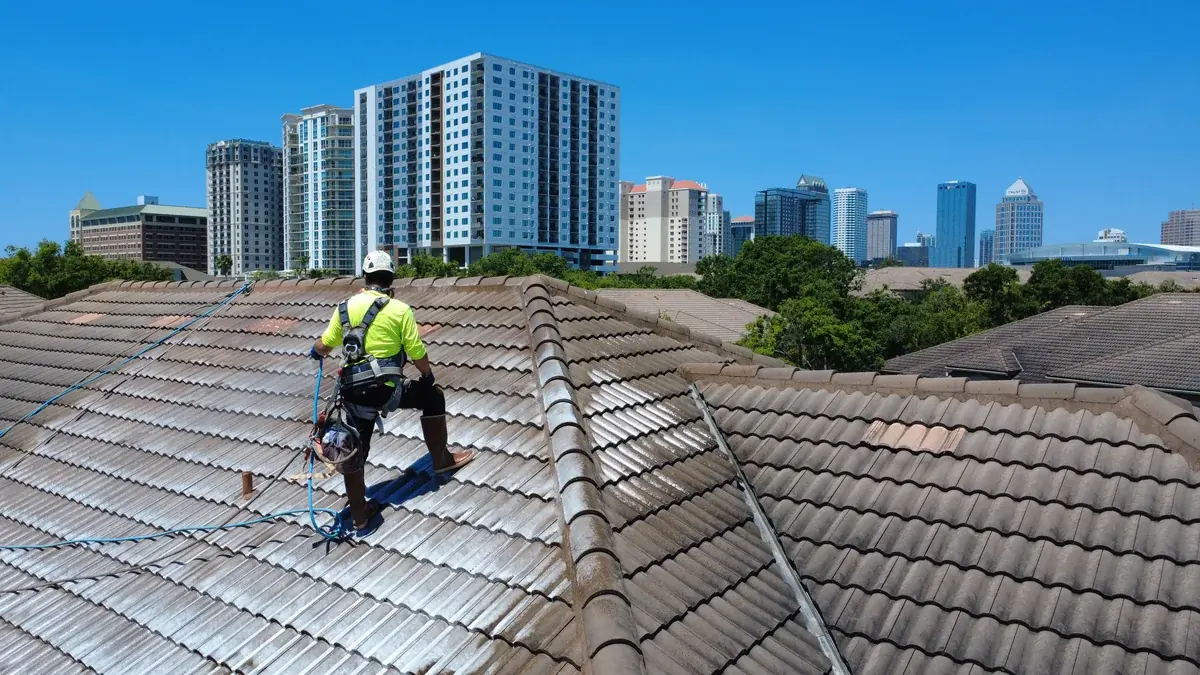
Every exterior cleaning contractor in Florida starts the same way: bolting a 12-volt diaphragm pump onto a wooden board or truck toolbox, wiring it to a deep-cycle marine battery, and pulling a batch mix or proportioner blend of 12.5% sodium hypochlorite (SH) to wash roofs and stucco homes. And make no mistake—12-volt soft wash systems are phenomenal money-makers that we still keep on our trucks as dedicated backup and spot-treatment units.
However, once you are out in the blazing Florida sun running a pump for hours on end, the physical realities of a spinning 12-volt electric motor, an all-or-nothing pressure switch, and nozzle backpressure become painfully obvious. Below, I am sharing my exact first-hand field experience—from melting 12-volt pumps and burning out switches on pristine pump heads to why I stepped down from 7 GPM to 5 GPM (and why I would choose a 2 to 3 GPM 12V today for precision control)—compared side by side against commercial Air-Operated Double-Diaphragm (AODD) Pumps (such as All-Flo, Yamada Kynar, and ARO PTFE) that have zero spinning parts.
1. How a 12-Volt Soft Wash System Works (And Why Heat, Trigger Tapping & Throttling Kill It)
A standard 12-volt soft wash setup—built around a Delavan 5850 12V Diaphragm Pump or 12-Volt On-Demand Chemical Pump—uses a spinning DC electric motor powered by a deep-cycle battery housed in a Marine Battery Box and maintained by an onboard Smart Marine Battery Charger, wired through a heavy-duty 12V Disconnect Power Switch and Waterproof Inline Fuse Holder.
"The most common application system for soft washing is a 12-volt diaphragm pump—an electric pump that pulls your solution from your tank or proportioner, runs it through the hose, and comes out your gun or wand... A proportioner is a tool you can add to your 12-volt, gas, or air diaphragm soft wash system to dial in exact mix ratios for roofs versus house washes." — Soft Wash Pump & Proportioner Architecture (zub1FG6tlH0)
While 12-volt pumps offer low startup cost ($180–$280), whisper-quiet operation, and fast manifold swaps, running them daily in Florida exposes four critical engineering limitations that every operator needs to understand:
- Spinning Motor Heat & Melting in the Florida Sun: Unlike an air diaphragm pump (which has zero spinning parts), a 12-volt pump relies on a high-RPM spinning DC electric motor that generates massive amounts of heat under extended operation. I have run 12-volt pumps to the point of melting and complete failure. If you are out in the hot Florida sun running a 12-volt pump for hours on end, you will cook the pump.
- Trigger Tapping Destroys the Pressure Switch on a Pristine Pump: Letting on and off the trigger of your Soft Wash Spray Gun is brutal on a 12-volt pump. Constant triggering cycles the micro-switch under heavy DC amperage (compounded by microscopic sodium hypochlorite vapor corrosion), causing premature failure of the switch alone. The entire pump body and diaphragm can be completely pristine, but without that tiny pressure switch, the pump is dead on the job site.
- All-or-Nothing Flow (Why You Cannot Throttle a 12V Pump with Smaller Tips): A 12-volt pump is all-or-nothing on flow. If you try to "throttle" a 7 GPM 12-volt pump to spray less by stepping down from a 7 GPM nozzle to a 5 GPM tip (or half-pulling the trigger), backpressure spikes and forces the pressure switch to rapidly switch on and off until failure. You must match a 5 GPM tip to a 5 GPM pump.
- Why I Dropped From 7 GPM to 5 GPM (And Why I Would Pick 2 to 3 GPM Today): When I first started out, I dropped down from a 7 GPM 12-volt pump to a 5 GPM model specifically because 7 GPM pushed way too much unthrottlable flow and its larger motor generated way more heat. The 5 GPM pumps use much smaller motors that run cooler. Honestly, if I were starting over on a 12-volt rig today, I would go even smaller—a 2 to 3 GPM 12-volt pump—for far better application control, drastically less heat generated by the motor, and lower battery amp draw. Yes, it is slower flow, but on a 12-volt system, control and thermal reliability beat raw GPM every time.
"I've used the air diaphragm pump, I've used the gas roof pump, and I've used the 12-volt... With gas roller/centrifugal pumps, sodium hypochlorite will eat right through the metal housings in a couple of months. The reason many operators keep 12-volt pumps on their trucks is redundancy—you can keep a spare pump on the shelf and swap it in minutes—while air pumps give you heavy commercial flow without metal parts in the bleach stream." — 12V vs. Gas vs. Air Soft Wash Pump Breakdown (OFaEzUbMpzM)
2. Why Commercial Operators Upgrade to Air-Operated Double-Diaphragm (AODD) Pumps
When you step up to a 1/2-inch or 3/4-inch All-Flo, Yamada, or ARO air-operated double-diaphragm (AODD) pump driven by a gas-powered air compressor (typically 12 to 18 CFM @ 100 PSI), there are zero spinning parts, zero electric motors, and zero pressure switches anywhere on the pump.
"On the left we have our air compressor that runs our air diaphragm pump... Inside here is our half-inch air diaphragm pump made with Kynar (PVDF) bleach-resistant parts, paired with an air dryer and our proportioner manifold, which pulls directly from the 200-gallon water tank, 55-gallon bleach tank, and surfactant tank—eliminating the need for batch mixing." — Commercial Air Diaphragm & Proportioner Skid Walkthrough (-ASimtN-8CY)
Here is why a Kynar (PVDF) or polypropylene AODD pump fitted with Santoprene or PTFE (Teflon) diaphragms is vastly superior in the exact areas where almost every other pump struggles:
- Zero Spinning Parts — Run 8 Hours Straight in the Hot Florida Sun: Because an AODD pump is driven purely by compressed air shifting two diaphragms back and forth (and expanding compressed air naturally cools the housing), there is no spinning electric armature generating friction or heat. I can run my AODD pump for 8 hours straight directly in the hot Florida sun without cooking a motor or melting a casing.
- Tap the Trigger 1,000× With Zero Consequence: With an AODD pump, I can tap the trigger—spray, stop, spray, stop, 1,000 times—and it has zero negative consequence on the pump. There is no electrical pressure switch to arc or burn out; when you let off the trigger, the pump simply pauses against line pressure, takes a break, and saves a little compressed air.
- Use ANY Tip Size & Throttle Flow Right at the Trigger: Whether your AODD is dialed to 5 GPM or 12 GPM, you can switch to and use any tip size on your 4-Nozzle J-Rod Holder to control flow without causing rapid switch chatter. Even better, you can throttle the trigger halfway to feather your flow on the fly around delicate landscaping, soffits, or pool cages, then squeeze full-open for a 45-to-55-foot wind-cutting stream through 250 feet of Kuriyama Braided Chemical Soft Wash Hose (essential for our No-Walk Barrel Tile Roof Protocol).
- PTFE (Teflon) & Kynar Chemical Immortality: By specifying polypropylene or Kynar (PVDF) pump casings with PTFE (Teflon) or Santoprene diaphragms and Viton check balls, 12.5% sodium hypochlorite cannot corrode the pump internals.
"With this 1-inch air diaphragm pump, the body is made out of poly and the inside diaphragms and check balls are made out of PTFE, which is Teflon—that's the best chemical-resistant internal material you can get on an air diaphragm pump for soft washing. The bottom port is your suction from the proportioner, and the top port is your discharge to the hose reel." — Air Diaphragm Pump Internals & Plumbing (22UPfFd2YV4)
3. Essential Plumbing, Valves & Hose Components for Either Soft Wash Build
Whether you run a dual-12V manifold or an All-Flo air diaphragm rig, your pump is only as reliable as the suction plumbing and spray gun attached to it. In our Tampa Bay trucks, every soft wash circuit uses these battle-tested components:
- Precision Metering Valves (
Spears/HaywardGate & Metering Valves): To dial in exact1.5%house-wash mixes versus5.0%barrel-tile roof mixes without batch-mixing in a tank, build your proportioner suction manifold with Spears 3/4-Inch Schedule 80 PVC Gate Valves and secure all suction barbs with marine-grade 316 Stainless Steel Hose Clamps so air leaks never cavitate your pump. - Kink-Free Chemical Delivery Hose: Never use cheap hardware-store vinyl tubing on the high-pressure discharge side of a soft wash pump—it balloons and bursts in 95°F Florida sun. Spool your reel with Kuriyama Kuri Tec Braided Chemical Hose and feed your buffer tank with a Flexzilla 5/8-Inch High-Flow Water Supply Hose.
- High-Reach Soft Wash Spray Guns: Pair your hose with a bleach-resistant Commercial Soft Wash Gun or Zoreblay ST-510 Soft-Wash Spray Gun fitted with a 4-Nozzle J-Rod Holder for instant switching between long-range stream tips and wide fan rinse tips.
- Mandatory Operator PPE: Always keep a 3M 6300 Half-Face Respirator with 3M 60923 Organic Vapor/Acid Gas Cartridges, 3M Splash-Proof Safety Goggles, and XTRATUF Non-Slip Deck Boots in the truck cab.
4. Head-to-Head Engineering Matrix: 12V Diaphragm vs. Air Diaphragm (AODD) vs. Gas Roof Pump
| Engineering Metric | 12V Electric Diaphragm Pump ( Delavan / Everflo / Remco) |
Air Diaphragm (AODD) Pump ( All-Flo / Yamada / ARO) |
Gas Engine Centrifugal Pump ( AR45 / Comet P40) |
|---|---|---|---|
| Real-World Flow Rate & Optimal Sizing | 2–3 GPM or 5.0 GPM preferred (7 GPM generates excessive motor heat & unthrottlable flow) | 5.0 – 12.0 GPM (Fully adjustable via air regulator & any tip size) | 9.0 – 12.0+ GPM |
| Motor Heat & Florida Sun Endurance | Spinning DC motor generates massive heat; extended hot-sun runs can cook & melt the pump | Zero spinning parts; runs 8 hours straight in direct Florida sun without overheating | Air-cooled gas engine; requires unloader bypass loop to prevent pump-head thermal spike |
| Trigger Tapping & Flow Throttling | All-or-nothing flow; downsizing tips (e.g. 5 GPM tip on 7 GPM pump) or constant trigger tapping rapidly cycles & kills the pressure switch | Tap trigger 1,000× (spray, stop, spray, stop) with zero wear; switch to any tip size or throttle the trigger directly |
Requires continuous bypass return line to tank whenever gun trigger closes |
| Vertical / Horizontal Spray Reach | 28 – 38 Feet | 45 – 55 Feet (Ideal for 2-story No-Walk tile roofs) | 50 – 60 Feet |
| Power Source Required | 12V Deep-Cycle Marine Battery + Charger | Gas Air Compressor (12–18 CFM @ 100 PSI) + Moisture Separator |
Dedicated Honda GX200 / GX390 Gas Engine |
| Primary Failure Point in 12.5% SH | Pressure Switch & Motor Heat (Switch fails on an otherwise pristine pump; $25 switch or $200 pump swap) | Air Moisture / Shuttle Valve (2–4+ years with daily flush & air dryer) | Pump head seals, aluminum manifold corrosion & gearbox oil emulsification |
| Total System Cost | $350 – $750 (Pump, battery, box & wiring) | $2,200 – $3,800 (AODD pump + gas air compressor + air dryer) | $2,400 – $4,200 |
🧮 Interactive Soft Wash Pump Selector & 3-Year TCO Calculator
Select your weekly roof/exterior wash volume, maximum story reach, and proportioning style to compare 3-year Total Cost of Ownership (pump replacements, switches, and time saved per roof) between a 12V Diaphragm rig and an All-Flo Kynar Air Diaphragm (AODD) system.

5. The Verdict: Which Soft Wash System Should You Run?
If you are launching your exterior cleaning business on a starter budget, skip the oversized 7 GPM 12-volt pumps that run hot and chew through pressure switches—instead, run a 2 to 3 GPM (or 5 GPM max) 12-volt diaphragm pump matched to its exact nozzle rating, keep a wired backup pump on the manifold, and avoid rapid trigger tapping. Once you are ready for true all-day reliability in the Florida heat, step up to an All-Flo or Yamada Kynar Air Diaphragm (AODD) system: zero spinning parts, 8-hour sun endurance, 1,000× trigger tapping without wear, and effortless flow control with any tip size or trigger feathering.
Want step-by-step plumbing diagrams, chemical metering math, and field SOPs? Enroll in our free training curriculum at academy.tbsoftwash.com—or if you are a Tampa Bay property owner who wants our commercial soft wash rigs on your property, request an instant estimate below or call Brian Vasquez and Jessica Lakins at (727) 641-1296.
🎓 Train With Us: Module 2: 12V Diaphragm vs. Air Diaphragm Soft Wash Pump Builds
Are you a contractor, technician, or hands-on property manager? Study our step-by-step operator checklists, safety non-negotiables, Proof Pack SOPs, and curated Amazon Gear Boxes in the free Tampa Bay Soft Wash Academy.
Open Lesson in Academy → academy.tbsoftwash.com