For multi-unit franchise operators, quick-service restaurant (QSR) general managers, high-volume coffee kiosks, and commercial bank branches along US-19, Gulf-to-Bay Boulevard, Dale Mabry Highway, and Ulmerton Road, the drive-thru lane is your highest-revenue square footage. In modern QSR operations, 65% to 80% of daily gross revenue flows through the drive-thru queuing lane, order menu board, and pickup window.
Yet when a regional franchise field consultant or health inspector pulls up to the speaker box, the concrete apron immediately beneath the order menu and pickup window is often a slick, blackened hazard zone coated in polymerized fryer oil tracked from kitchen backdoors, leaking transmission fluid, spilled dairy/syrup beverages, and hundreds of flattened wads of chewing gum. Even worse, assigning night-shift restaurant employees to hose down the lane with a consumer cold-water pressure washer merely emulsifies the surface film and pushes Fats, Oils, and Grease (FOG) toward municipal storm grates—violating Clean Water Act NPDES Stormwater Regulations and Pinellas County Environmental Management illicit-discharge ordinances.
1. The 4 Contamination Zones of a Tampa Bay Commercial Drive-Thru
Unlike residential driveways—where staining is 95% biological (Gloeocapsa magma algae, mildew, and oak leaf tannins)—a commercial QSR, pharmacy, or bank drive-thru suffers from a multilayered chemical matrix that standard bleach (sodium hypochlorite) cannot break down:
- Zone 1 — The Speaker Box & Pickup Window Idle Pad (Hydrocarbons + Sugars): Vehicles idle in the exact same tire tracks 600 to 1,200 times per day, dropping hot synthetic motor oil, power-steering fluid, air-conditioning condensate, and brake dust directly onto porous broom-finished concrete, topped by spilled sodas, iced coffees, and milkshakes.
- Zone 2 — The Kitchen Backdoor & Dumpster Pad Track-Out (Animal & Vegetable FOG): Every time staff wheel trash carts from the back-of-house kitchen to the dumpster enclosure, saponifiable triglycerides (fryer oil and animal fats) coat the concrete service walk, attracting rodents, cockroaches, and slip-and-fall claims under OSHA 29 CFR 1910.22 walking-working surface rules.
- Zone 3 — Storefront Sidewalks & Entry Thresholds (Oxidized Chewing Gum): High foot traffic bakes discarded synthetic polyisobutylene chewing gum into the concrete pores, creating black polka-dot blisters across your entrance walk.
- Zone 4 — Canopy Eaves, Menu Boards & Stucco Clearance Bars (Carbon Soot + Mold): Diesel and gasoline exhaust plumes rise into drive-thru awnings and clearance bars, bonding greasy black carbon soot with Florida mildew.
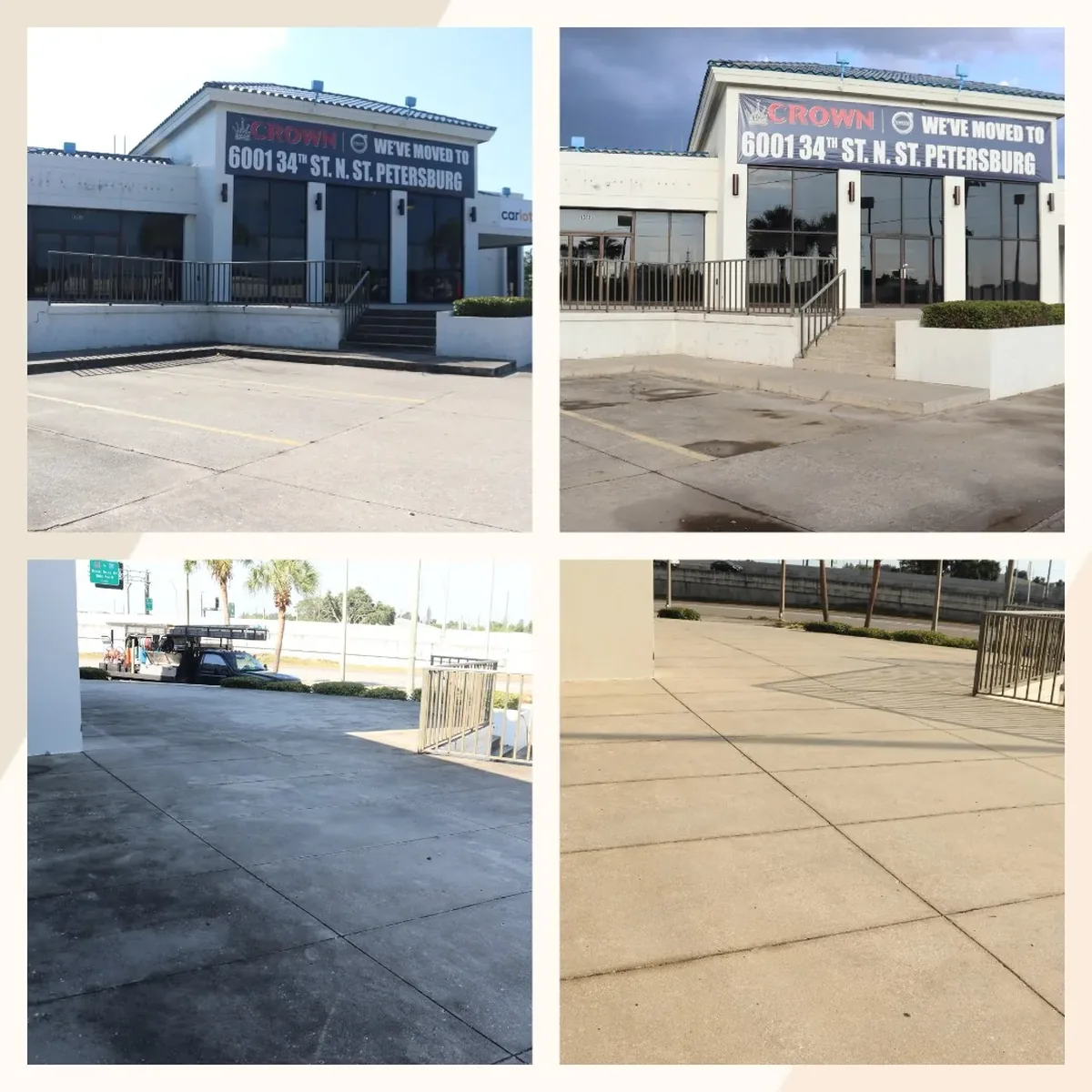
"Watch us melt away years of dirt and grime from this concrete sidewalk using a professional surface cleaner. Keeping your walkways clean prevents slip hazards and instantly boosts curb appeal!" — Brian Vasquez, Tampa Bay Soft Wash & Pressure Cleaning (`nfQCCccSd_4`)
2. Chemistry Over PSI: Why Sodium Hydroxide Saponification Beats Cold Water
Many property managers wonder why their maintenance crew's 3,500 PSI cold-water pressure washer fails to remove drive-thru grease. Basic chemistry explains why: water and lipids are immiscible, and sodium hypochlorite (`SH` bleach) only oxidizes living organic matter—it has zero chemical reaction with petroleum hydrocarbons or vegetable fats.
To truly extract polymerized food grease and motor oil from concrete pores without blasting away the sand-and-cement top cream at destructive pressures, commercial technicians rely on alkaline saponification using Commercial Sodium Hydroxide (Caustic Soda Beads) combined with biodegradable surfactants:
"Today I'm at a local coffee place... and I've got a contract set up with these guys to clean up the drive-thru concrete... In this bucket I've got five gallons of water and I'm using sodium hydroxide—I did 16 ounces or 2 cups in there... and let it dwell for 20 minutes." — Commercial QSR Drive-Thru Degreasing Field Protocol (`qXbGU2moAMo`)
- The Saponification Reaction (`NaOH` + Triglycerides): When a metered solution of sodium hydroxide (`pH 13–14`) is applied via our General Pump High-Draw Chemical Injector or dedicated pump sprayer and given 15 to 20 minutes of dwell time, the hydroxide ions cleave the ester bonds in animal and vegetable fats—converting water-insoluble grease into water-soluble soap and glycerol that lifts cleanly out of the concrete capillaries.
- Surfactant Cling & Emulsification: Adding a foaming surfactant (such as Commercial Degreasing Surfactant) prevents premature evaporation on warm Florida concrete while encapsulating petroleum drips so they do not re-deposit down-gradient.
- Strict PPE & Neutralization: Because caustic degreasers require professional handling, our technicians operate in full LANON Chemical-Resistant Nitrile Gloves, 3M Splash-Proof Safety Goggles, and XTRATUF Slip-Resistant Deck Boots, neutralizing and rinsing the pad thoroughly with high-flow MTM Hydro DN10 High-Pressure Ball Valves so zero slippery residue remains when your morning opening shift arrives.
"I'm about to go clean some restaurants right now... This is caustic soda beads and the active ingredient in caustic soda beads is sodium hydroxide. And sodium hydroxide is also the active ingredient that is in commercial degreaser... We're going to put 16 ounces in each five-gallon container, and then we're going to put a squirt of surfactant just to help it foam a little bit more so we can help it cling to the areas that we're spraying it on." — Commercial Restaurant Degreasing Chemistry (`nFh8K_3BkTM`)
3. Concrete vs. Asphalt Transitions & Zero-Etch Chewing Gum Extraction
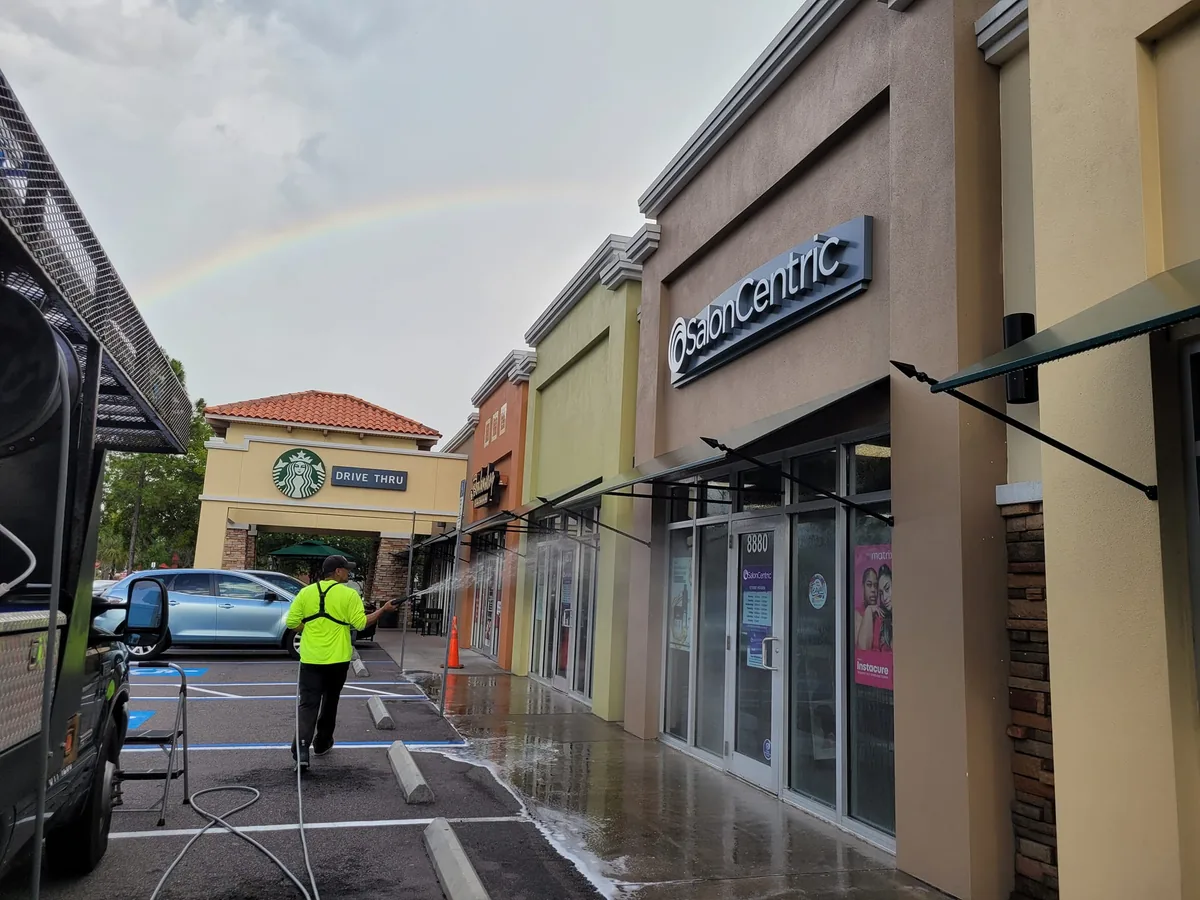
Most commercial drive-thrus in Clearwater, Largo, St. Petersburg, and Tampa feature poured concrete pads at the speaker and pickup window that transition into blacktop asphalt queuing lanes. Amateur pressure washers ruin property budgets by running high-PSI rotary surface cleaners across asphalt transitions or etching permanent "wand graffiti" circles into concrete while trying to blast off chewing gum.
"We never do drive-thrus when they're open, but you can go all the way around the right side and the left side, all the way around with 200 foot of high pressure hose and not have to move your trailer... We're gonna start to clean only the concrete. We don't ever surface clean asphalt—spot treat and brush and ball valve this." — After-Hours QSR Drive-Thru Workflow (`VMyByvX1sWI`)
Our commercial SOP separates concrete flatwork from asphalt and uses controlled nozzle physics for gum removal:
- Concrete Pad Rotary Pass + Post-Treatment: We clean poured concrete aprons and sidewalks using balanced commercial rotary surface cleaners paired with non-marking 3/8-Inch Non-Marking High-Pressure Hoses, followed by a 1.5% sodium hypochlorite post-treatment to eliminate subsurface organic spores and prevent swirl marks.
- Asphalt Transition Protection: We never run high-pressure rotary bars over asphalt. Oil and beverage spills on asphalt queuing lanes are spot-treated with biodegradable degreaser, agitated with stiff nylon brushes, and flushed with high-volume low pressure via our ball valve.
- Controlled-Angle Chewing Gum Extraction: Using a calibrated fan tip held at a 45-degree shearing angle (or thermal treatment), we pop petrified chewing gum blisters off the concrete surface without gouging the cement paste.
"Commercial concrete gum removal demonstration by Tampa Bay Soft Wash & Pressure Cleaning—lifting embedded chewing gum deposits cleanly off Tampa Bay sidewalks and drive-thru walkways without scarring the concrete substrate." — Brian Vasquez, Tampa Bay Soft Wash & Pressure Cleaning (`2DOLu9ACj6s`)
4. Commercial Service Frequency Matrix & Predictable Monthly Recurring Pricing
Whether you manage a single chick-fil-a/coffee franchise, a regional portfolio of 12 QSR locations, a retail shopping plaza, or a community bank branch, sporadic once-a-year cleaning guarantees permanent oil shadowing and failed brand audits. Below is our commercial frequency benchmark for Tampa Bay facilities:
| Facility Type | Recommended Cadence | Core Scope of Work | Typical Tampa Bay MRC Range |
|---|---|---|---|
| High-Volume QSR & Coffee Drive-Thru (800+ cars/day, fryer/dairy FOG) |
Bi-Weekly (14-Day) or Monthly (After-hours `10 PM – 5 AM`) |
Speaker/window pad caustic degreasing, dumpster pad sanitation, storefront sidewalk gum removal & post-treat | $275 – $495 / visit (Volume multi-store discounts available) |
| Pharmacy, Dry Cleaner & Casual Dining Drive-Thru | Monthly or Bi-Monthly | Drive-thru concrete lane surface cleaning, hydrocarbon spot-treating, canopy soffit soft wash & entry walks | $295 – $550 / visit |
| Bank Branch ATM Lanes & Medical Office Porticos | Quarterly (90-Day) | Multi-lane ATM concrete cleaning, rust/irrigation stain removal, building facade & drive-under canopy soft wash | $395 – $750 / quarter |
| Retail Strip Plazas & HOA Clubhouse Entries | Quarterly or Semi-Annual | Full common sidewalk rotary cleaning, gum removal, curbing, dumpster enclosures & monument signage | Custom Sq. Ft. Contract (Bundled with HOA/CAM Playbook) |
🧮 Interactive QSR & Commercial Drive-Thru MRC & Chemistry Calculator
Select your facility profile, concrete apron size, and service cadence to calculate your estimated per-visit rate, annual maintenance budget, and required sodium hydroxide (`NaOH`) saponification batch mix.
5. Why Franchise Operators & Property Managers Partner With TB Soft Wash
Commercial property managers do not fire exterior cleaning vendors over $25 price differences—they fire vendors who miss overnight windows, leave wand stripes at the front door, or show up without valid commercial insurance. When you onboard Tampa Bay Soft Wash & Pressure Cleaning as your recurring exterior maintenance partner, you receive:
- Verified $1,000,000 Commercial General Liability COI: Underwritten by Progressive Commercial (`Policy #4608294299`), with same-day Additional Insured certificate issuance for your franchise entity or property management group.
- Owner-Operated Accountability & OSHA Compliance: Led directly by Brian Vasquez (OSHA-10 `#36-007022186`, TIA Certified Technician, Trident T3 Master Sealer `#67509e11547140e2ae06ded7`) and Jessica Lakins—backed by a 4.9 ★ rating across 137 verified Google reviews.
- Automated Photo Verification Logs for Absentee Managers: After every overnight or early-morning service, your regional manager receives timestamped before-and-after photos along with proactive facility notes (alerting you to roof leaks, damaged curbing, or pest/bird issues before corporate auditors see them).
- Stormwater & Grease-Trap Responsibility: We block storm drain inlets during heavy degreasing, neutralize caustic wash water, and never blast solid dumpster debris into municipal retention systems.
Ready to put your restaurant drive-thru, bank branch, or commercial plaza on autopilot? Request your commercial walkthrough and complimentary test-pad demonstration below, or call our commercial desk directly at (727) 641-1296.
🎓 Train With Us: Module 7: Commercial Drive-Thru & Caustic Degreasing SOPs
Are you a contractor, technician, or hands-on property manager? Study our step-by-step operator checklists, safety non-negotiables, Proof Pack SOPs, and curated Amazon Gear Boxes in the free Tampa Bay Soft Wash Academy.
Open Lesson in Academy → academy.tbsoftwash.com