If you manage a restaurant, retail shopping center, supermarket loading dock, medical facility, or multi-family condominium complex in Clearwater, St. Petersburg, Largo, Dunedin, or Tampa, your dumpster pad is the most abused concrete slab on your property. Every week, heavy front-load waste trucks compact garbage bags until dark "dumpster leachate"—a toxic slurry of rancid fryer oil, rotting proteins, soured dairy, and acidic liquids—leaks out of rusted container drain plugs and bakes onto the 140°F Florida concrete.
Even worse, adjacent tallow/used-cooking-oil (UCO) rendering barrels frequently overflow when kitchen staff empty fryer vats at night or when collection trucks tip barrels during pumping. Within days, that quarter-inch layer of animal and vegetable Fats, Oils, and Grease (FOG) polymerizes into a sticky black crust that attracts Norway rats, German cockroaches, and filth flies, sends foul odors drifting across your outdoor dining patio or condo pool deck, and triggers immediate citations during unannounced Florida DBPR Division of Hotels and Restaurants health inspections.
#4608294299)? Visit our Commercial Pressure Washing Services page or call (727) 641-1296 for priority scheduling.
1. Why Cold Water & Consumer Bleach Fail on Restaurant Dumpster Pads
A common mistake made by restaurant managers and condo maintenance janitors is dragging a garden hose and a jug of household bleach out to the dumpster enclosure. Neither cold water nor sodium hypochlorite alone can cut through a grease-caked dumpster pad, because you are fighting two completely different chemical enemies simultaneously:
"We've got this grease receptacle back here... Sanitation company came out here, knocked over the barrels, and just made this huge mess. This grease is really thick on the concrete—in some places it's probably a quarter of an inch thick... Kitchen grease is different than the synthetic grease that drips from cars in a parking lot; this is an organic triglyceride grease and we use a caustic detergent specifically designed to cut kitchen grease." — Commercial Dumpster Pad Grease Remediation (AYti1KOat0E)
- Organic Triglycerides (Fryer Oil, Tallow & Dairy Fats): Kitchen grease consists of long-chain fatty acid esters that are 100% hydrophobic. Cold-water pressure washing simply liquefies the top layer and splatters rancid grease onto the enclosure walls, gates, and adjacent cars without breaking the chemical bond inside the concrete pores.
- Anaerobic Bacteria, Maggot Larvae & Mold Spores: Beneath the grease crust, anaerobic bacteria ferment trapped sugars and proteins, producing butyric acid and hydrogen sulfide (the unmistakable "rotting dumpster" stench). Until you strip away the grease cap first, sanitizers cannot reach the bacterial biofilm underneath.
- Compacted Organic Muck & Loose Debris: Blasting loose trash, decomposed food solids, and mud directly with a high-pressure wand blows foul debris across the parking lot and clogs nearby storm drains.
"One of the first things that we're going to have to do is come in here with trash grabbers and a square-point shovel and physically remove the loose junk, weeds, and compacted muck, putting them into the dumpster—that's a lot cleaner and more compliant than trying to pressure wash solid muck into the parking lot. Then we pre-sanitize and degrease." — Commercial Dumpster Corral SOP (rUphdY0TAwI)
2. The 4-Stage TB Soft Wash Dumpster Pad & Loading Dock Sanitization Protocol
At Tampa Bay Soft Wash & Pressure Cleaning, we treat dumpster corrals, compactor bays, and supermarket loading docks as biohazard and heavy-degreasing zones—wearing full OSHA-compliant PPE including 3M Half-Face Respirators, 3M Splash-Proof Safety Goggles, LANON Chemical-Resistant Nitrile Gloves, and Dunlop Chemical-Resistant Protective Boots:
- Stage 1 — Dry Mechanical Scrape & Biocidal Pre-Spray: Before turning on a high-pressure pump, we shovel up loose solid waste, scrape caked tallow deposits around rendering barrels, and mist the enclosure walls and floor with a pre-sanitizing sodium hypochlorite solution (
3%SH) via our Delavan 12V Soft Wash Pump to neutralize airborne pathogens and odor bacteria immediately. - Stage 2 — Alkaline Saponification with Sodium Hydroxide (
NaOH): Next, we apply a heavy concentration of Commercial Sodium Hydroxide (Caustic Soda) blended with high-cling surfactant. During a 15- to 20-minute dwell window, the high-pH caustic solution reacts with animal and vegetable triglycerides (saponification), converting thick water-insoluble fryer grease into water-soluble soap that releases from the concrete substrate. - Stage 3 — High-Flow Rotary Surface Cleaning & Turbo-Nozzle Corner Detail: We clean the main slab with industrial rotary surface cleaners and cut through stubborn corner and bollard buildup using a High-Impact Rotary Turbo Nozzle and MTM Hydro DN10 Ball Valve.
- Stage 4 — Biocidal Deodorizing Post-Treatment: Finally, we apply a fresh sanitizing and odor-eliminating post-treatment across the concrete pad, masonry enclosure walls, vinyl/metal gates, and exterior dumpster faces—leaving the corral smelling clean and hospital-fresh.
"This is caustic soda beads and the active ingredient in caustic soda beads is sodium hydroxide. And sodium hydroxide is also the active ingredient that is in commercial degreaser... We put 16 ounces in each five-gallon container with surfactant to help it foam and cling to the areas we're spraying it on." — Sodium Hydroxide Saponification Chemistry (nFh8K_3BkTM)
3. Stormwater Compliance: Protecting Pinellas & Hillsborough Storm Drains (Pinellas Ch. 58 Art. VI & NPDES)
Under the federal Clean Water Act Section 402 (NPDES), the South Florida Clean Coastal Waters Act, and local Pinellas County Code Chapter 58, Article VI / Hillsborough County MS4 ordinances, discharging non-stormwater pollutants—including emulsified restaurant grease, caustic wash water, or active sodium hypochlorite—into a curb inlet or retention pond is strictly illegal. Because Tampa Bay storm drains flow directly into creeks, lakes, and the Intracoastal Waterway without treatment (where the EPA freshwater aquatic life benchmark for total residual chlorine is just 0.019 mg/L), illicit discharges carry municipal fines of up to $10,000 per day for both the contractor and the commercial property owner.
"First thing you want to check on water recovery is to identify where your storm drains are. Second, you want to identify the direction the water is flowing... because if wash water goes into that storm drain, one, you get a big ticket, two, you can lose your license, and three, it'll pollute the creek water and lakes." — Commercial Wash-Water Containment & Stormwater Protection (lp9G2ZfuQsU)
Before our crew begins any commercial dumpster pad or loading dock wash, we inspect the site drainage grade, deploy physical interception berms and oil-absorbent booms around down-gradient storm grates, scrape up solid waste prior to washing, and apply sodium thiosulfate (Na2S2O3) neutralization (which chemically converts residual hypochlorite into inert chloride and sulfate) while recovering or diverting effluent safely into vegetated buffer zones or sanitary cleanouts.
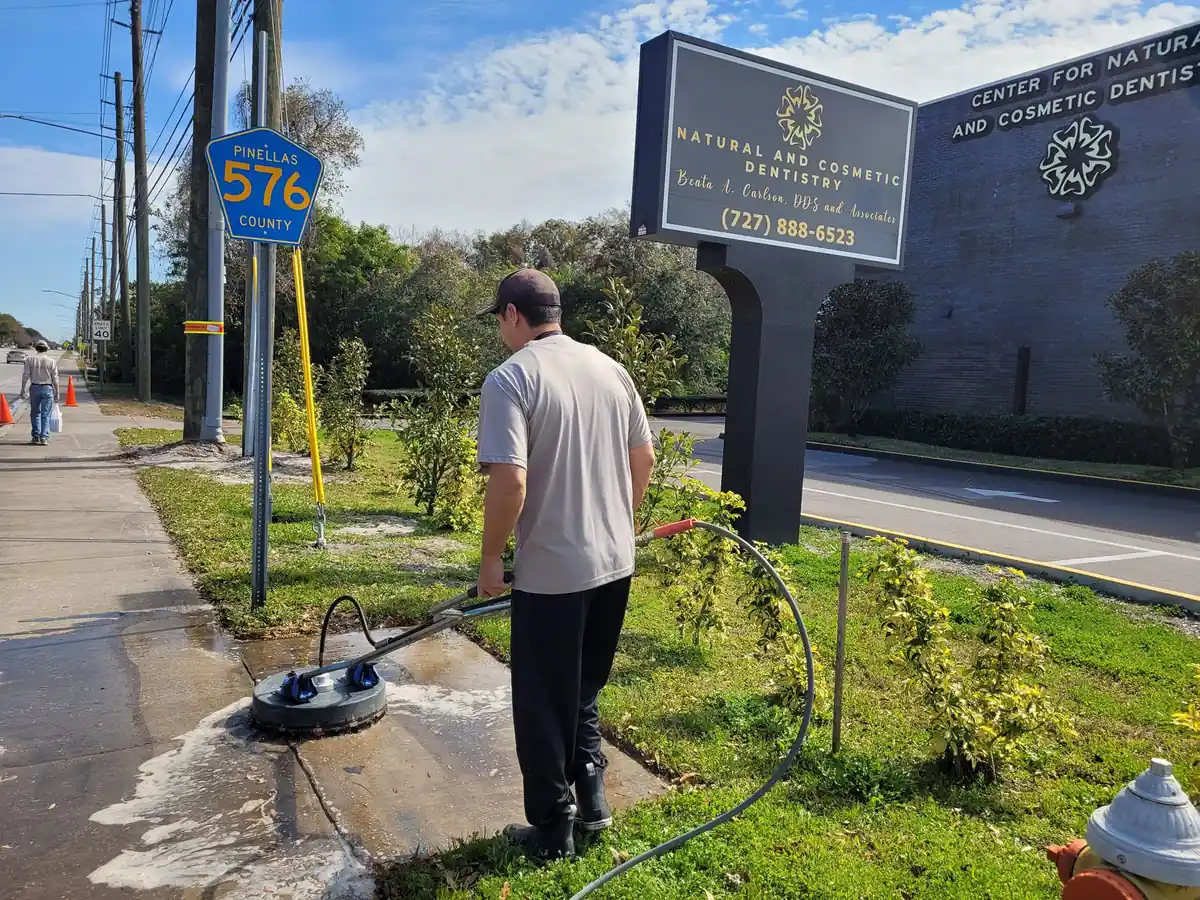
"Watch us melt away years of dirt and grime from this concrete sidewalk using a professional surface cleaner. Keeping your walkways clean prevents slip hazards and instantly boosts curb appeal!" — Brian Vasquez, Tampa Bay Soft Wash & Pressure Cleaning (nfQCCccSd_4)
4. Commercial Dumpster Pad & Loading Dock Maintenance Cadence Matrix
| Facility Type | Recommended Cleaning Cadence | Primary Risk if Neglected | Bundled Commercial Route Options |
|---|---|---|---|
| Full-Service Restaurants & QSRs with UCO Grease Barrels | Bi-Weekly (14-Day) or Monthly | DBPR health inspection citations, severe rodent/roach harborage, employee backdoor slip-and-falls (OSHA 1910.22) | Bundle with QSR Drive-Thru Lane & Sidewalk Degreasing |
| Grocery Stores, Butcher/Seafood Markets & Multi-Bay Loading Docks | Monthly | Rancid protein/dairy leachate odors, hydraulic liftgate fluid slicks, and pest attraction | Loading dock apron, compactor bay, and storefront entry walkway cleaning |
| Condo Towers, Apartment Complexes & HOA Compactor Corrals | Monthly or Quarterly | Resident odor complaints, raccoon/rat infestations, and stained common-area roadways | Bundle with HOA & Condo Common-Area Maintenance |
| Retail Strip Centers, Medical Offices & Dry-Waste Corrals | Quarterly (90-Day) | Black mildew buildup on enclosure walls, rust stains, and overflowing contractor debris | Full plaza sidewalk gum removal, curbing, and awning soft wash |
🧮 Interactive Dumpster Pad & Loading Dock Sanitization Calculator
Configure your dumpster corral size, waste profile, and recurring route schedule to calculate caustic saponification + SH sanitization requirements and per-visit commercial pricing.
5. Schedule Your Commercial Dumpster Pad & Loading Dock Route Today
Whether you need a one-time emergency grease cleanup before a corporate audit or want to combine your dumpster pad sanitization with our Monthly Drive-Thru & Storefront Cleaning Route, Tampa Bay Soft Wash & Pressure Cleaning delivers reliable, owner-operated execution backed by 137 verified Google reviews (4.9 ★) and a verified $1,000,000 Progressive Commercial Liability COI (#4608294299). Request your commercial proposal below or call (727) 641-1296.
🎓 Train With Us: Module 7: Commercial Dumpster Pad Saponification & NPDES Compliance
Are you a contractor, technician, or hands-on property manager? Study our step-by-step operator checklists, safety non-negotiables, Proof Pack SOPs, and curated Amazon Gear Boxes in the free Tampa Bay Soft Wash Academy.
Open Lesson in Academy → academy.tbsoftwash.com