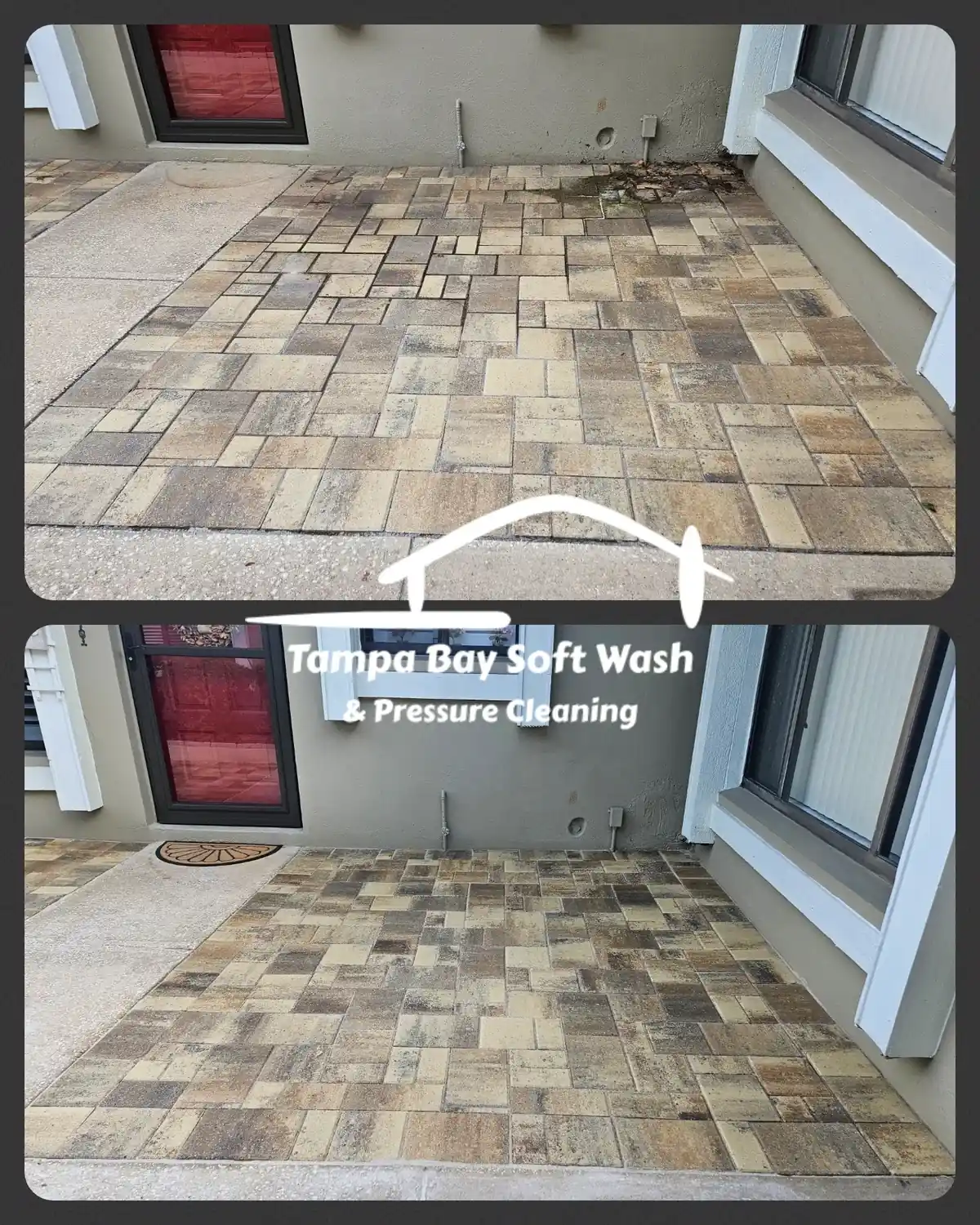
Every week across Clearwater, Dunedin, Palm Harbor, St. Petersburg, and Westchase, our phone rings with the same heartbreak: a homeowner paid $1,500 to an unlicensed handyman—or spent an entire weekend rolling on 5-gallon buckets of hardware-store "wet-look" sealer—only to wake up 48 hours later to a driveway or lanai that looks like someone spilled skim milk across the bricks.
Even worse, if they swept pre-mixed "polymeric sand" into the paver joints before sealing, the humid Florida afternoon rain re-activated the dry polymer binder on top of the bricks, leaving a cloudy, gummy, crusted gray film across the entire patio. Once a topical acrylic film delaminates ("blushes") or traps subsurface calcium carbonate efflorescence, you cannot fix it by rolling another coat of sealer on top. In fact, adding more sealer only thickens the moisture barrier and turns a manageable chemical strip into a multi-day mechanical restoration.
140°F+ vehicle tires ("hot tire pickup"). Rolling more sealer over white or flaking pavers fails permanently. Professional chemical stripping with Trident Protects Break Wall / Sea Wall dissolves 100% of the failed film so joints can be re-sanded with ASTM C-144 angular silica and sealed with breathable Trident Hurricane CAT 4/5, Typhoon, or Cyclone. Call (727) 641-1296 for a T3 Certified evaluation.
1. The 4 Culprits Behind White, Cloudy, or Peeling Florida Pavers
Before we mix a single gallon of restoration chemistry, our first job on-site is diagnosing what is turning white, flaking, or holding black tire tracks on your pavers. In Pinellas and Hillsborough counties, paver sealer failure falls into four distinct chemical categories:
"When an acrylic sealer turns white, it's a sign that the sealer has delaminated or lost its bond with the surface. The most common reason is when the sealer is introduced to water or moisture during the curing process... A second reason a sealer turns white is when the sealer was applied in the middle of the day when air and surface temperatures are above the suggested application temperature range." — Concrete & Paver Sealer Delamination Physics (PqaEtWBnn9o)
- Topical Sealer "Blushing" (Hydrostatic Moisture Entrapment): Unlike northern states where pavers sit over deep crushed-gravel frost bases, Florida pavers sit on a shallow 1-inch sand setting bed directly above a high coastal water table in an environment averaging 74%+ year-round relative humidity (especially in coastal ZIP codes like
33755,33767,33756, and34698). When groundwater vapor rises through the porous concrete brick and hits a non-breathable, big-box solvent or cheap acrylic film, microscopic water droplets condense inside the resin. Light refracts off millions of trapped micro-bubbles, turning the clear coat opaque white. - Trapped Calcium Carbonate Efflorescence (
CaO → Ca(OH)2 → CaCO3) & Violating the 30–90 Day Cure Rule: Concrete pavers contain water-soluble calcium oxide (CaO, free lime) inside the Portland cement matrix. When rainwater or irrigation enters the microscopic capillaries of the brick,CaOreacts with water (H2O) to form calcium hydroxide (Ca(OH)2), migrates to the surface, and reacts with atmospheric carbon dioxide (CO2) to leave behind a white powdery deposit of calcium carbonate (CaCO3)—known as efflorescence. New pavers must breathe and weather naturally for 30 to 90 days after installation; if a contractor seals them prematurely or fails to neutralize efflorescence with Trident Protects Jetty, those mineral salts are locked permanently under the chemical barrier. - Polymeric Sand Haze & Binder Washout: Pre-bagged polymeric sand was engineered for dry climates where contractors do not flood-coat joints with liquid urethane sealer. In Tampa Bay's 74%+ relative humidity and daily summer downpours, polymeric additives absorb ambient moisture, swell out of the joints, turn slimy under pool-deck foot traffic, and leave a permanent cloudy polymer haze across textured pavers and travertine.
- Peeling, Flaking & Black Tire Marks ("Hot Tire Pickup"): Why is your paver sealer peeling in driveway wheel tracks? Off-the-shelf thermoplastic acrylic sealers have a low glass-transition temperature (
Tg). When you drive home on summer Florida asphalt, your tires exceed140°F–160°F. Parking hot tires on a cheap thermoplastic sealer softens the resin and triggers plasticizer migration—bonding the sealer to the rubber tread so it rips, flakes, and peels off the brick when you back out, or permanently embeds black vulcanized rubber marks into the softened film. Unlike single-part hardware-store acrylics, Trident Protects Hurricane CAT 4 & CAT 5 are cross-linked 2-part urethanes engineered to resist thermal softening and hot tire pickup.
"If you have recently had pavers installed and you are now noticing that there are white spots forming on the surface, don't panic. This is called efflorescence... Since all concrete products contain cement, once that starts to hydrate, it can produce a salt. This salt is known as calcium hydroxide. When the calcium comes to the surface of the paver and reacts with the air, you'll begin to see efflorescence form." — Paver Efflorescence Chemistry (VZkWC77vSiI)
2. Why We Strictly Ban Polymeric Sand & Use ASTM C-144 Washed Silica + Flood-Coat Sealer
One of the most common myths repeated by weekend DIY videos is that you should sweep polymeric sand into Florida pavers and then spray a sealer over top. In reality, combining polymeric sand with a professional flood-coat sealer is a recipe for catastrophic failure:
- Polymeric Crusting Blocks Sealer Penetration: Polymeric sand forms a thin glue crust only at the very top 1/8-inch of the joint, leaving the bottom 2 inches of sand loose and unstabilized. When liquid sealer is flood-applied over polymeric sand, the sealer cannot penetrate the joint, pooling on top and turning white.
- Algae & Mold Feed on Organic Polymer Binders: Within 6 to 9 months in shaded Florida lanais, black algae and green moss colonize the organic polymers in polymeric sand, turning every joint black.
- The Trident + ASTM C-144 Solution: At Tampa Bay Soft Wash & Pressure Cleaning, we strictly install clean, kiln-dried or washed angular silica sand meeting ASTM C-144 masonry gradation standards. Because ASTM C-144 silica grains are sharp and angular (unlike round play sand) and contain zero artificial glues, our flood-applied Trident Protects sealer saturates deep into the sand bed—chemically fusing the angular quartz grains into a rock-hard, breathable, weed- and ant-resistant joint from top to bottom.
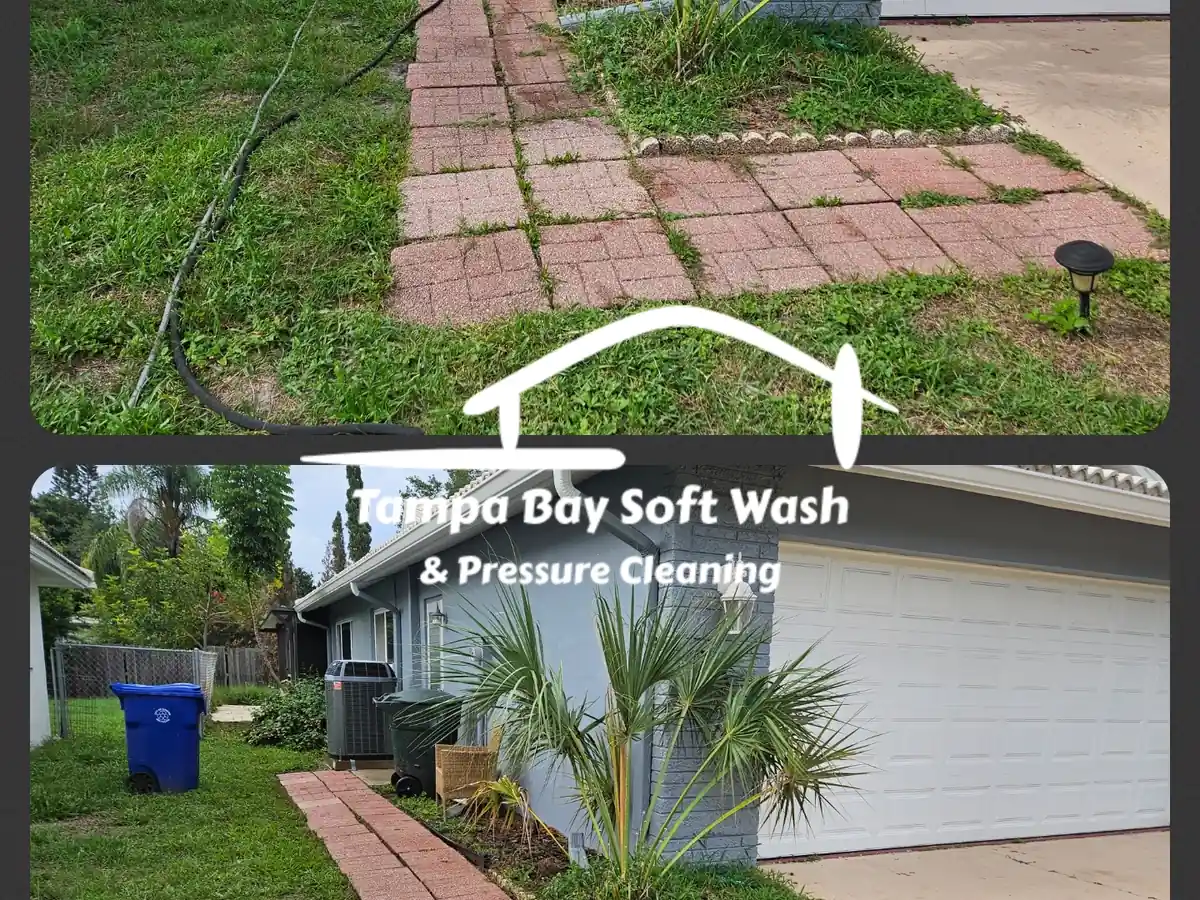
3. The 5-Step Trident Strip & Rescue Protocol
When we are called in to rescue a driveway or pool deck ruined by white hazy sealer, we execute a disciplined 5-step chemical and mechanical restoration protocol:
"We're at a location where the customer picked one of those sealers from the local department store and has regretted it the moment he put it down, but we're here to fix it... Now we started rolling on the stripper here. See how it's all hazed up? ... It's really expensive to have to strip an old sealer before we can actually get to that actual restoration process. You see that? It almost looks like paint, but it's not—it's the sealer and it clouded up." — Florida Paver Sealer Stripping Rescue (ATJC8iIAPvM)
- Step 1 — Chemical Sealer Stripping with Trident Break Wall / Sea Wall: Wearing full chemical PPE—including a 3M 6300 Half-Face Respirator fitted with 3M 60923 Organic Vapor/Acid Gas P100 Cartridges, LANON Chemical-Resistant Nitrile Gloves, and Dunlop Chemical-Resistant Protective Boots—we apply Trident Protects Break Wall or Sea Wall commercial stripper to emulsify and lift the failed acrylic or solvent coating from the paver pores.
- Step 2 — High-Flow Rotary Extraction & Joint Flush: Once the old film blisters and softens, we shear away the emulsified resin using our commercial pressure washing rig and flush the contaminated polymeric sand out of the joints using high-volume MTM Hydro DN10 Ball Valves and Commercial Rotary Turbo Nozzles on stubborn edge buildup.
- Step 3 — Efflorescence & Pore Conditioning with Trident Jetty: Next, we treat the bare concrete pavers with Trident Protects Jetty surface prep chemistry to dissolve trapped calcium carbonate efflorescence, rust, and organic tannins—opening the microscopic capillaries of the brick so the new sealer can achieve maximum mechanical bond.
- Step 4 — Wet-Sluice Joint Compaction with ASTM C-144 Silica Sand: We hydro-compact clean ASTM C-144 angular washed silica sand deep into every joint to a uniform depth 1/8-inch below the paver chamfer edge.
- Step 5 — Flood-Coat Application of Trident Protects Breathable Sealer: Finally, we apply the exact Trident Protects sealer matched to your substrate and desired sheen.
"As you can see this kind of white film that's on top of my pavers... To remove the old sealer, I'm using an etching and stripping clean solution mixed 1-to-1 after wetting the pavers down, scrubbing with a stiff nylon brush, and stripping it off with a pressure washer before resealing." — Paver Film Removal & Surface Prep (GaH0PeKLiRg)
4. Trident Protects Sealer Comparison Matrix: Choosing the Right Chemistry for Your Florida Pavers
Because Tampa Bay Soft Wash & Pressure Cleaning is a certified Trident Protects dealer and applicator, we never gamble with hardware-store buckets. Here is how our exclusive Trident chemistry lineup matches every Tampa Bay hardscape surface:
| Trident Protects Product | Chemistry Class | Finish / Color Enhancement | Best Tampa Bay Applications |
|---|---|---|---|
| Hurricane CAT 5 | Commercial 2-Part Water-Based Urethane | Deep Rich Wet Look / High Gloss + Maximum Joint Stabilization | High-traffic concrete brick driveways, commercial plazas & luxury motor courts |
| Hurricane CAT 4 | 2-Part Urethane Sealer | Vibrant Wet Look / Gloss Sheen + Hard Joint Lock | Residential brick paver driveways, walkways & entry courtyards |
| Typhoon | Breathable Water-Based Modified Acrylic | Enhanced Color / Semi-Gloss Satin Sheen | Patios, lanais, and HOA driveways requiring rich color without high gloss |
| Cyclone | Breathable Water-Based Acrylic | Natural Look / Low Sheen + Joint Stabilization | Homeowners & strict HOA boards wanting joint lock with a subtle natural matte finish |
| Tsunami | Penetrating Silane-Siloxane Hydrophobic Sealer | 100% Invisible Natural Finish (Zero Topical Film) | Turkish travertine pool decks, marble, shellstone & poured concrete driveways |
| Jetty & Break Wall / Sea Wall | Efflorescence Cleaner (Jetty) & Industrial Sealer Strippers (Break Wall / Sea Wall) |
Surface Prep & Coating Removal | Stripping white failed sealer, removing efflorescence salts & opening paver pores |
🧮 Interactive Trident Protects Sealer, Stripper & ASTM C-144 Sand Estimator
Enter your paver or travertine square footage, current surface condition, and desired Trident Protects finish to calculate exact material quantities (ASTM C-144 silica sand bags + sealer gallons) and turnkey restoration pricing.
5. SWFWMD Water Shortage Exemptions & How to Book Your Paver Rescue in Pinellas or Hillsborough
Many Tampa Bay homeowners ask whether paver cleaning and restoration is allowed during Southwest Florida Water Management District (SWFWMD) Modified Phase III Water Shortage Orders. While SWFWMD prohibits purely cosmetic DIY driveway pressure washing (carrying fines starting at $193 and doubling on repeat offenses), the regulations include an explicit statutory exemption for pressure washing conducted as surface preparation prior to sealing or painting, or to remediate slippery algae/mold safety hazards—meaning our Trident Protects restoration and sealing service is 100% compliant year-round.
Stripping a failed paver sealer is specialized chemical restoration work—typically ranging from $2.75 to $4.50+ per square foot depending on how many layers of old solvent or acrylic sealer are caked onto the brick—compared to standard clean-sand-and-seal pricing on unsealed or properly maintained pavers. Attempting to blast cloudy pavers with a DIY pressure washer cannot penetrate the failed chemical film and only drives moisture deeper into the slab.
Don't let trapped moisture or failed polymeric sand ruin your hardscape investment: Whether you need an emergency strip-and-rescue on a milky white driveway in Clearwater (33755, 33767), Belleair (33756), Dunedin (34698), or Palm Harbor (34683, 34685), or want your travertine pool deck sealed with breathable Trident Tsunami or Hurricane CAT 5 in St. Petersburg (33701), South Tampa (33606, 33629), or Westchase (33626), Tampa Bay Soft Wash & Pressure Cleaning brings 4.9-star rated (137 verified Google reviews) craftsmanship and a $1,000,000 Progressive Commercial Liability Policy (#4608294299) to your property. Lock in your instant restoration estimate above or call (727) 641-1296 to book an on-site chemical strip test patch today.
🎓 Train With Us: Module 8: Trident Paver Stripping, Sealing & ASTM C-144 Sand System
Are you a contractor, technician, or hands-on property manager? Study our step-by-step operator checklists, safety non-negotiables, Proof Pack SOPs, and curated Amazon Gear Boxes in the free Tampa Bay Soft Wash Academy.
Open Lesson in Academy → academy.tbsoftwash.com