Bigger Hose Is Better
3/8″ is typically too small for a soft wash system unless you are using a very small pump, such as a 1 GPM pump. A 1/2″ hose or larger is recommended for 5 GPM pumps, and 5/8″ or larger for 7 GPM pumps. A 3/4″ hose is pretty much where the size stops because anything larger becomes a bit too strenuous to pull in the field.
Which brings me to my next point: garden hoses. Garden hoses are typically 5/8″ to 3/4″ for a reason. Don’t get me wrong, you can find 1/2″ water hose, but it does not provide the flow that we have all grown accustomed to.
Just remember: the bigger the hose, the better. It does not matter if you are only using a 2 GPM pump—the bigger the hose, the better it is for the life and efficiency of the pump. The only downside to having a large hose is the weight: the difference in weight between a fully filled 1/2″ hose and a 3/4″ hose is significant.
Garden Hoses Will Work For Soft Washing
On a budget? Get yourself some garden hoses and mend 200 feet together using hose mend kits. You can even link a 5/8″ hose to a 3/4″ hose. While garden hoses may not be the best long-term option for soft washing, they can get the job done.
I do not recommend connecting garden hose heads utilizing standard garden hose threading. If you are transferring gallons and gallons of chemicals around a client's property, you should minimize the possibility for leaks. Garden hose fittings tend to leak. I suggest using a double-sided hose barb and 2 stainless steel hose clamps.
Non-Collapsible Suction Hose

When plumbing the intake, do not use the same flexible hose that you plan on using to actually soft wash with. You should use at least 3/4″ non-collapsible suction hose. Do not confuse poly-braid hose for non-collapsible hose. Non-collapsible hose is rigid-walled and designed specifically for suction.
Yes, you can get away with using regular hose, but you run the risk of the hose collapsing and restricting the flow. If there is one thing you don’t want, it is any flow restrictions—especially if you plan on hooking up a chemical blend manifold.
The same logic applies to the size of the intake hose: the bigger the better. If you can feed your pump with 1″ non-collapsible hose, that is even better!
Alternative Drop Sticks
Instead of making a standard drop stick, I go about it a little differently. Instead of plumbing a PVC drop stick to a bulkhead and then that bulkhead to hose with a hose clamp, I suggest eliminating the possibility for air leaks and just dropping the suction hose directly into the tank. To hold the hose straight in place, run it through a sleeve of PVC pipe. If you downstream, you probably already understand this simple, leak-free setup.
Avoid 90-Degree Fittings
One last thing that pertains to plumbing: you want to avoid all 90-degree elbow fittings whenever possible. If you have to make a turn, sweep your hose gently into the turn instead of forcing an abrupt 90-degree angle. Also, don’t leave excess intake hose coiled in loops. You want to create the path of least resistance for your fluid to travel.
The Best Hoses For Soft Washing (Top 4)
- 300′ 1/2″ Kuriyama Kuri Tec: Kuriyama Kuri Tec K1176-08X300 Series General Service PVC Air and Water Hose
- 250′ 1/2″ Flexzilla Pro Spool: Flexzilla Pro 1/2″ x 250′ Water Hose Bulk Spool
- 250′ 5/8″ Flexzilla Pro Spool: Flexzilla Pro 5/8″ x 250′ Water Hose Bulk Spool
- 100′–300′ 5/8″ Braided PVC Tubing: High-Pressure Clear Braided PVC Vinyl Tubing (or Maxx Flex Clear Braided PVC Chemical Tubing)
All of these hoses will get the job done—it just depends on your preference and budget.
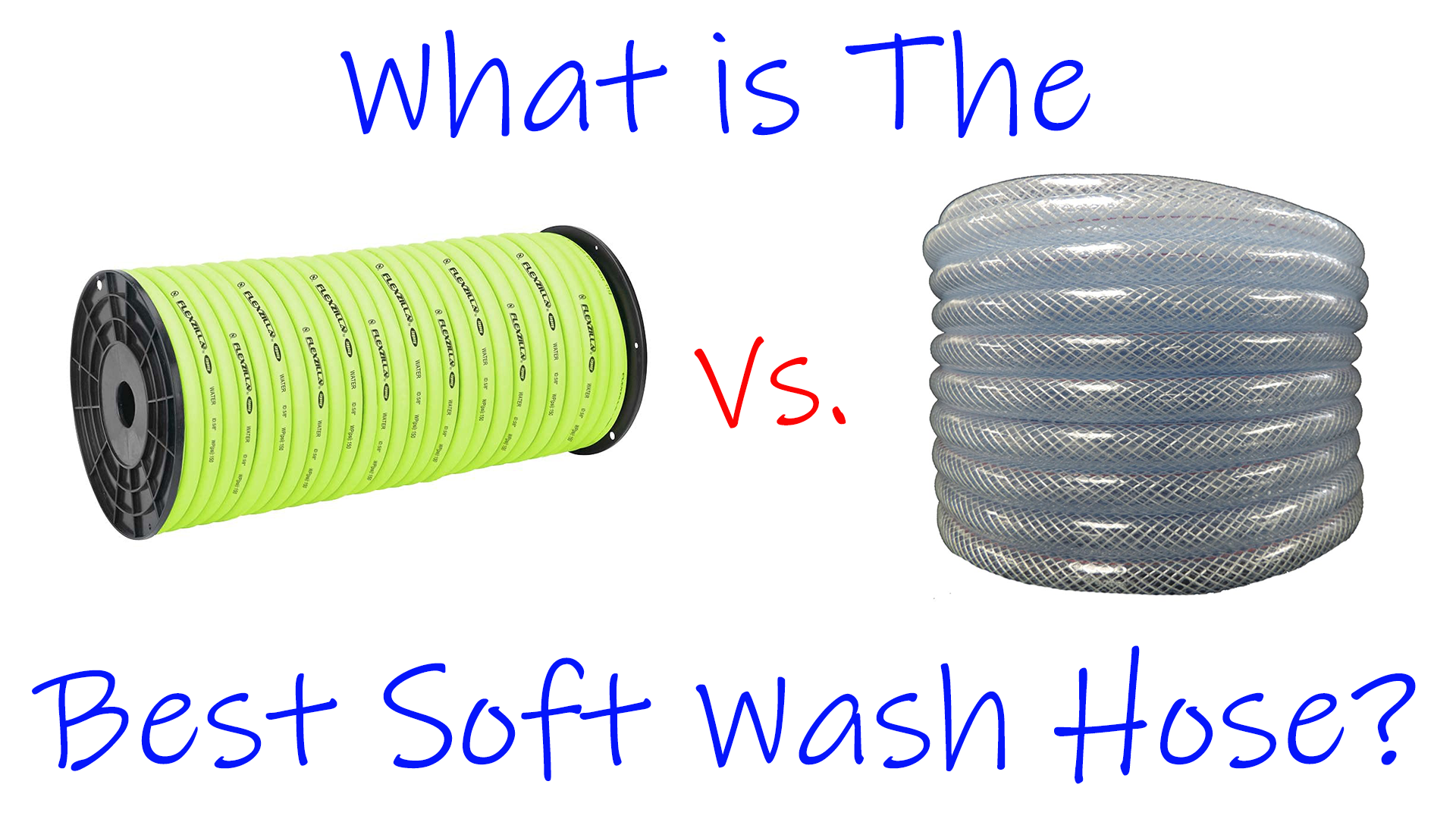
The short and sweet on Flexzilla vs. braided PVC hose: I personally feel braided PVC is more durable against abrasion, though it is more prone to kinking (especially in a spot that has previously been creased), while Flexzilla is better at flexing and resisting kinks—though don’t be fooled, all hoses can kink.
The vast majority of soft washing veterans in Pinellas County, Florida will tell you the 1/2″ Kuri Tec is the “best” all-around choice. While this is generally true, it doesn’t take into account what size pump and what length of hose are needed. As a rule of thumb, the further you run, the larger diameter you want. Running the first 100′ at 3/4″ or 5/8″ and the second 100′ at 1/2″ is a great way to preserve flow and reduce weight at the gun.
While 200′ is enough to do the vast majority of residential jobs, it is always a good idea to carry an extra 50′ to 100′ of hose and a hose mend kit just in case your hose bursts in the field.
Our Soft Washing Hose Choice
We ended up choosing the 5/8″ clear braided PVC hose for four main reasons:
- Durability: Braided PVC hoses are tough and less prone to puncturing when dragged over concrete and sharp edges.
- Visibility: Because it’s clear, you can immediately see chemical flow, air bubbles, or blockages inside the line.
- UV Longevity: After years of Florida sun, the exterior of our clear braided PVC hose does not get sticky or gummy from UV exposure, whereas some polymer jackets degrade over time.
- Cost Efficiency: Getting 200′–300′ of 5/8″ braided PVC hose costs a fraction of specialty chemical hoses while delivering outstanding flow.
🎓 Go Deeper: Equipment Recommendations
Compare hose materials, chemical compatibility, and sizing recommendations in our free Academy course.
Start Learning → academy.tbsoftwash.com👍 Did this guide help you?
Give us a like on Facebook and follow @tbsoftwash on Instagram, YouTube, TikTok, and Twitter for more professional cleaning tips!
📍 For expert soft washing & pressure cleaning in Tampa Bay, visit tbsoftwash.com or contact us for a free estimate!