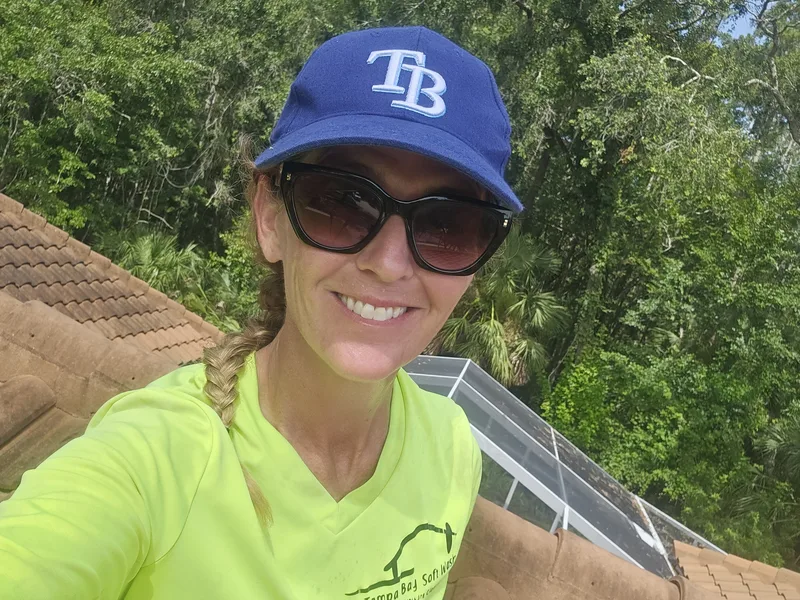
Professional exterior cleaning gear can cost thousands, putting a major barrier between you and a clean, mold-free home. In this guide, we'll show you exactly how to build a powerful, budget-friendly soft wash system using accessible parts to safely treat delicate surfaces. If you’re not the DIY type, Tampa Bay Soft Wash provides comprehensive exterior cleaning services throughout Clearwater, FL.
We have prepared some guidelines on how we would personally proceed. We are not saying it is better or worse, it is just what we would do. Although it isn’t the simplest of things, if you do it well enough, you should have a pretty decent soft washing setup that can generate money on a daily basis. I can personally say that our few hundred dollar chemical pumps have generated us a lot more money than our few thousand dollar pressure washer pumps…
What is Soft Washing?
Before you learn how to build a budget soft wash system, we want to explain a few things about what soft washing is.
Soft washing is a cleaning technique that involves spraying a cleaning solution to eliminate living microorganisms such as algae, bacteria, molds, and mildews. These microorganisms commonly occupy the exterior of structures, especially on the north face and any other shaded areas of the structure. You should periodically remove them since they not only look unsightly, they can cause deterioration in the quality of roofs and various sidings, become slip-hazards, and even pose some health risks .
The most optimal and flexible option would be to use a soft washing system. I want to emphasize that you can also soft wash with a pressure washer by utilizing a downstream injector and the proper nozzles. That method is useful, however, it limits you in the strength of the cleaning solution that you can apply and is a bit more prone to creating overspray. A soft wash system will allow you to shoot full-strength chlorine if the job calls for it. You could never accomplish that with a pressure washer and a downstream injector. The “downstream” process requires at least a 4 to 1 ratio. That would be 80% water that is introduced and mixed with the cleaning solution, which ultimately dilutes the strength. However, if the job only calls for a 1% or 2% solution, downstreaming can be very time efficient and may be the best option!
We suggest soft washing the exterior of structures instead of pressure washing because it is gentle on the materials. If used incorrectly, a pressure washing system can permanently damage some commonly used exterior materials, especially shingles on a roof! That is why roofing manufacturers wouldn’t replace damaged shingles that were still under warranty if they know they were cleaned with a pressure washer.
Now that you know what soft washing is and its functions, let’s get on with how you can build one for yourself.
Principles For Building A Soft Wash System
There are a couple of principles for building soft wash systems that I want you to keep in mind.
First, hose diameter. Simply put, the bigger the better. Your system will function much more efficiently utilizing 3/4″ instead of 1/2″ hose. The only downfall to going with 3/4″ are the weight and cost. But as far as functionality for the actual soft wash system, 3/4″ is far superior.
The same logic applies to electrical. The bigger the better…
Next, when plumbing (or wiring) everything together, think about the path of least resistance. When you mount everything, you don’t want any hard 90 degree turns or U-turns. The shorter and smoother the run, the better. Meaning, you don’t want a 15′ intake line doing a bunch of turns. Or your battery mounted 10′ away from your pump and switch.
How to Build a Budget Soft Wash System
What you will need:
- Bleach tank (the cheapest option is to buy 1 or 2 plastic 55-gallon drums locally for $20–$40 each)
- 250′ of 1/2″ hose or 5/8″ hose (combining garden hoses will also work)
- Non-collapsible suction hose
- Stainless steel hose clamps
- Soft wash gun (ST-510 style) (DIY guns are also possible)
- 12-volt on-demand chemical pump (must have Viton/Santoprene seals)
- Quad-Port / 1/2″ x 3/4″ poly hose barb (for 12-volt pump and 3/4″ suction hose)
- Quad-Port / 1/2″ x 5/8″ poly hose barb (needed if you purchase 5/8″ hose)
- Quad-Port / 1/2″ x 1/2″ poly hose barb (needed if you purchase 1/2″ hose)
- 12-volt deep-cycle marine battery (or buy a Group 27/34 marine battery locally for $100–$150)
- Battery charger / maintainer
- 12V toggle power switch
- Inline fuse harness (10AWG SAE with ATC fuses)
- SAE electrical wiring options (optional):
Assembly Steps:
- Connect the pump to the 12-volt battery with the power switch and the inline fuse.
- Check to make sure the pump is fully functional before plumbing your lines.
- Plumb the short non-collapsible suction hose to the intake port of the 12-volt pump using a stainless steel hose clamp. Drop the other end of that intake hose into your bleach tank (run it through a PVC sleeve to hold it straight at the bottom of the tank rather than adding leak-prone bulkhead fittings).
- Plumb the long discharge hose to the outlet of the 12-volt pump using a stainless steel hose clamp. Note: 5/8″ hose can fit snugly over a 3/4″ barb by warming the hose end briefly with a heat gun or dipping it in hot water before sliding it onto the barb.
- Connect your soft wash gun to the other end of the long delivery hose and test for leaks with clean water.
There are many ways to configure a rig—just make sure your pump is mounted securely and all tanks and batteries are strapped down. Tipping over 55 gallons of roof mix can have disastrous consequences.
Sodium Hypochlorite, Surfactant, and Water
Now that you have your soft wash system up and running, you will need to know the right chemicals and concentrations. All professionals use sodium hypochlorite (SH), better known as liquid chlorine, to eliminate algae, mold, and mildew. Surfactant is added as a wetting agent to help the active ingredient cling and dwell longer, and water is added to dial in the target dilution.
House washes typically require a 1% to 2% solution on the surface, while roofs typically require 3% to 6% depending on the roofing material and severity of organic growth.
The essence of soft washing, unlike pressure washing, is to kill molds, mildews, and algae at the root with chemistry—not blast them with damaging high pressure.
I Cleaned This Roof With a 5 GPM 12-Volt Pump
Frequently Asked Questions (FAQ)
Q: Is a soft wash system different from a pressure washer system?
A: Yes. A soft wash system uses a dedicated low-pressure chemical transfer pump (typically 12V or air-diaphragm), while a pressure washer uses a high-pressure water pump. A soft wash pump can deliver undiluted or custom-blended sodium hypochlorite solutions up to 6%+, whereas a pressure washer’s downstream injector dilutes chemical at roughly 4:1 to 10:1.
Q: Is soft washing safe for house roofs?
A: Not only is it safe, low-pressure chemical treatment is the official method recommended by the Asphalt Roofing Manufacturers Association (ARMA).
Q: Should I soft wash regularly?
A: That depends on the surface material and shade coverage. Vinyl or painted stucco siding can stay clean for 1–2+ years, while shaded roofs and porous concrete in Florida’s humidity benefit from periodic preventative maintenance.
In Summary
We hope the steps detailed here help you build an affordable, reliable starter soft wash system. If you’d rather hire a licensed and insured soft washing company for your property in Pinellas County, don’t hesitate to contact us!
🎓 Go Deeper: System Setup & Hardware
Learn the complete system architecture, pump selection, and plumbing layout in our free Academy course.
Start Learning → academy.tbsoftwash.com👍 Did this guide help you?
Give us a like on Facebook and follow @tbsoftwash on Instagram, YouTube, TikTok, and Twitter for more professional cleaning tips!
📍 For expert soft washing & pressure cleaning in Tampa Bay, visit tbsoftwash.com or contact us for a free estimate!